
Jefferson County Parole Versus Probation
Probation and parole are not two names for the same status. Probation is a sentence or judgment that lets a person remain in the community under court-set terms. In Oregon, a person leaving state prison often enters post-prison supervision. Some older or special cases use parole, which involves release authority exercised by the Oregon Board of Parole and Post-Prison Supervision. Jefferson County Adult Community Corrections may supervise people in either local probation or state post-prison cases when they live in or are assigned to Jefferson County.
The event dates also differ. Physical release ends confinement at one facility. Supervision may begin that day and last beyond it. A later discharge ends the supervision term. It must not be treated as the prison release date. The judgment, DOC record, Board Action, and Community Corrections record each document a distinct part of that timeline.
| Point | Probation | Parole or post-prison supervision |
|---|---|---|
| Starting authority | Court judgment | State sentence, release law, or Board order |
| Custody before supervision | Prison is not always required | Usually follows Oregon prison custody |
| Best status record | Court file and Community Corrections | OOS, Board or DOC record, and Community Corrections |
| End point | Court or agency discharge | Discharge from post-prison or parole supervision |
- Parole
- Conditional release from prison in a case governed by parole law and Board authority.
- Probation
- A court-ordered community sentence with rules and supervision.
- Post-prison supervision
- Community oversight that begins after an Oregon prison term.
- Discharge
- The formal end of supervision, which is separate from release from confinement.
Verify Jefferson County Release Supervision
No public Jefferson County named-person supervision search or county absconder list was found. Verification therefore uses a short chain of official sources. Start with the system that imposed or carried out the sentence. A Jefferson County jail booking alone does not prove probation. Likewise, a DRCI record does not show that Jefferson County is the assigned supervision county. Use identifiers and the case record before calling the local office.
- Search the Oregon Offender Search by full or partial name or SID. Compare age, date of birth, offenses, status, location, and caseload.
- Check Oregon VISOR for a current custody or supervision indicator. Treat it as updated notice, not a certified record.
- Review the Jefferson County court judgment for probation terms, or identify the Board or DOC order that governs a state release.
- Call Jefferson County Adult Community Corrections at 541-475-6145 with the name, SID or case number, and caseload clue. Ask what public status can be confirmed.
- Request the judgment, Board Action, or DOC and Community Corrections record when formal proof of supervision or discharge is needed.
A match in one live system is a useful lead. Strong confirmation ties it to the same person and sentence. The broader Jefferson County released inmate search explains how a county booking, state commitment, court case, and transfer record fit together.
Jefferson County Supervision Office Details
Jefferson County Adult Community Corrections supervises county residents assigned to probation or post-prison supervision. It is not a list of every person once held at Jefferson County Jail. The agency reports a supervised population of about 270. Most person-to-person contacts occur at the office, while home contacts may be announced or unannounced.
The current county page and a statewide directory conflict on the street address. One identifies 66 SE D Street. The other identifies 243 SW 3rd Street, Suite A. Calling first is essential. The phone number is the stable routing detail supplied by the county research.
Adult Community Corrections
Phone: 541-475-6145
Area served: People living in or assigned to Jefferson County
Visit: Confirm the working Madras address by phone before traveling
The official supervision office page shows the local program and its current contact presentation.
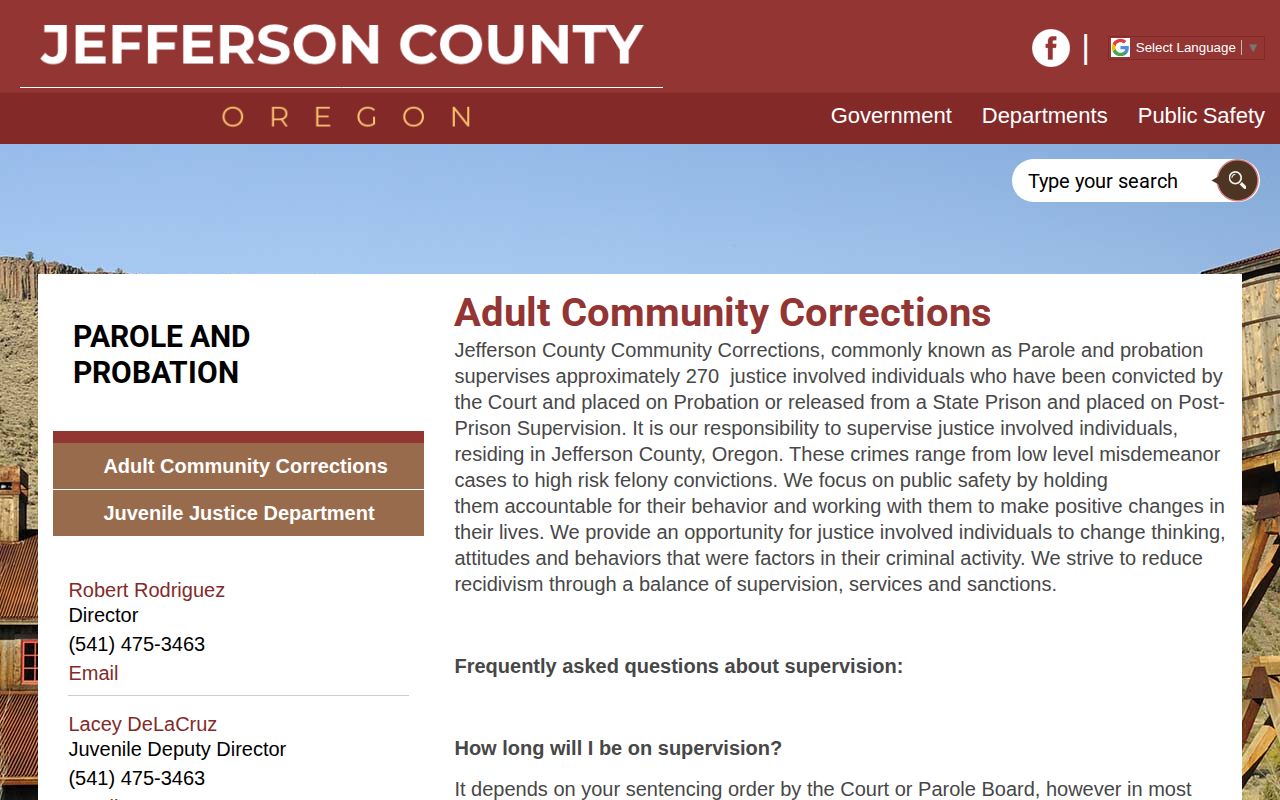
The captured office page is the correct local source, but the address conflict means the phone check should remain part of any planned visit.
How Jefferson Supervision Contacts Work
Jefferson Community Corrections says contact frequency is based on the case. Home visits can range from weekly to only a few times each year. Most direct contacts take place at the office. Those facts describe the county's working model, not a fixed schedule for every supervised person. A court sentence, Board order, assessed risk, conduct, and current direction can all shape the actual plan.
The county also reports that supervision often runs for 12, 24, or 36 months. Some people may qualify for early discharge around the midpoint, yet qualification is not automatic. Never add half the term to a release date and call that the discharge date. The agency or court record must show the actual change.
For family planning or personal contact, ask the supervised person or responsible office about lawful reporting needs. Do not assume that a home visit means a violation. Both announced and unannounced visits are part of the local practice described by the county.
Note: Local contact frequency varies widely, so a quiet period does not show that Jefferson County supervision has ended.
Jefferson County Violations and Warrants
Conditions are rules attached to probation, parole, or post-prison supervision. The controlling judgment or order matters. Jefferson County describes a range of responses to violations, from a verbal reprimand to jail. Other responses can include work crew, electronic monitoring, assigned tasks, and more reporting. This range means that an alleged violation does not by itself establish a warrant, jail return, or revocation.
An absconder is a person alleged to have stopped reporting or left supervision without authorization. Jefferson County does not publish a verified public absconder list. Rumor, social posts, and lists from counties with the same name are not substitutes. Contact Community Corrections or the agency responsible for a public warrant record. If custody resumes, VISOR may show a later event, though its data are periodic and nonofficial.
Revocation has a specific meaning. It is an official decision that supervision is revoked, often followed by custody or a new disposition. The Board may conduct a Future Disposition proceeding after parole revocation to decide rerelease or more imprisonment. Ask for the resulting order rather than reducing all outcomes to “passed” or “failed” supervision.
Jefferson County Parole Board Records
The Oregon Board hearings page has a dynamic Master Calendar. It presents individual events, not a fixed weekly or monthly release list. Since May 7, 2025, its notice says hearings occur in person within OSP or OSCI, subject to advance DOC clearance and visitation rules. A listed hearing is not an outcome.
Hearing results vary by type. A Prison Term hearing may set or decline to set a projected parole date. An Exit Interview may affirm or defer one. Personal Review, Murder Review, Parole Postponement, dangerous-offender review, and Future Disposition each answer different legal questions. The final written Board Action is the key result document.
No public named-person Board decision search was found. Use the Board records request. Give the person's name and SID, hearing date and type, and ask for the outcome plus later modification, postponement, revocation, rerelease, or discharge. ORS 144.135 requires parole-decision bases in writing. The Board reports that most Board records are kept for ten years and most adult-in-custody records for 25 years.
Eligibility is tied to the offense, judgment date, and controlling statute. ORS 144.120 supplies initial-hearing timing for terms to which it applies, with periods based on sentence length and important exceptions. It is not a universal date for modern Oregon releases. Dangerous-offender review, youth-offense release hearings, and murder cases use their own provisions. That is why the conviction statute and final written action should travel with any claimed parole date.
A scheduled event can also change. Misconduct, an evaluation, a parole plan that is not yet adequate, or a required legal finding may lead to postponement or deferral. Public attendance rules do not turn the calendar into a results search. When the outcome matters, request the order and ask whether a later Board Action changed it.
Jefferson County Supervision Discharge
Supervision ends through an authorized discharge, not through silence in a search result. ORS 144.085 supplies rules for active supervision periods, possible inactive status, and extensions. Its application depends on the sentence and status. Older parole rules also have limited, offense-specific reach. The note tied to ORS 144.110 limits classic matrix provisions in many settings to crimes before November 1, 1989 and certain murder cases.
Request the record that fits the source of authority. For probation, obtain the court entry or Community Corrections record. For Board parole, seek the Board Action and any discharge order. For post-prison supervision, DOC, the court, and Community Corrections records may each show part of the result. Keep prison release and supervision discharge as separate dates.
Eligibility never guarantees the end date. Conduct, extension authority, sanctions, a new case, and the terms of the judgment or Board order may affect it. When a future custody end date is also at issue, the Jefferson County inmate release date page distinguishes a DOC projection from actual release and later discharge.
Note: A community caseload can confirm the supervision route, while a final order supplies the strongest proof that the term ended.